An original American Civil War wargame

Command the Civil War on the maps the armies used.

Hold the high ground, use the woods, turn a flank. Fight First Bull Run, Antietam, Gettysburg, Shiloh, Chickamauga, Atlanta and Grant's long road to Appomattox on the period surveys, and learn how the war was really fought.

Free on iPhone, iPad and Mac, with eighteen battles included.

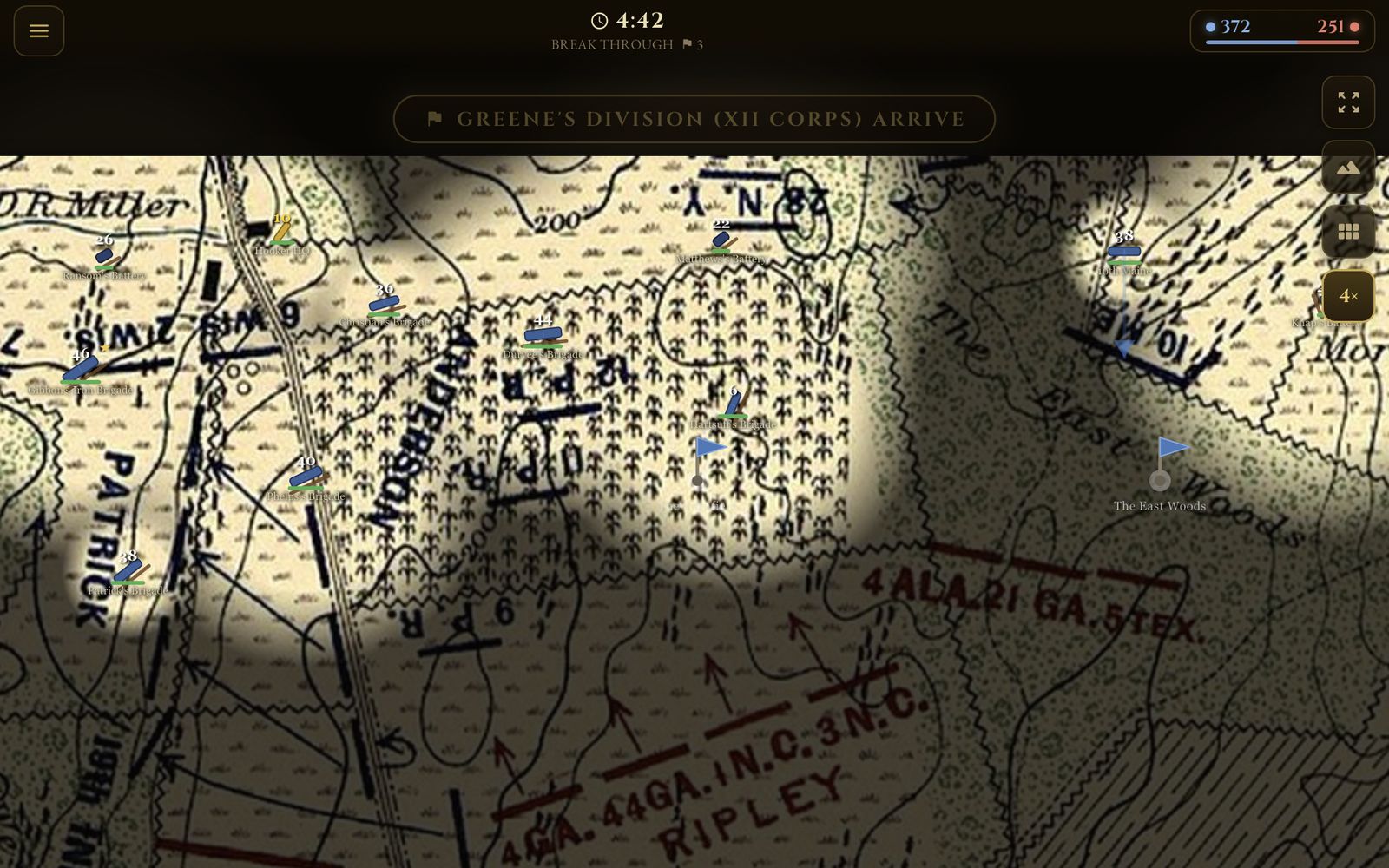
The Cornfield at Antietam on Ezra Carman's 1904 survey
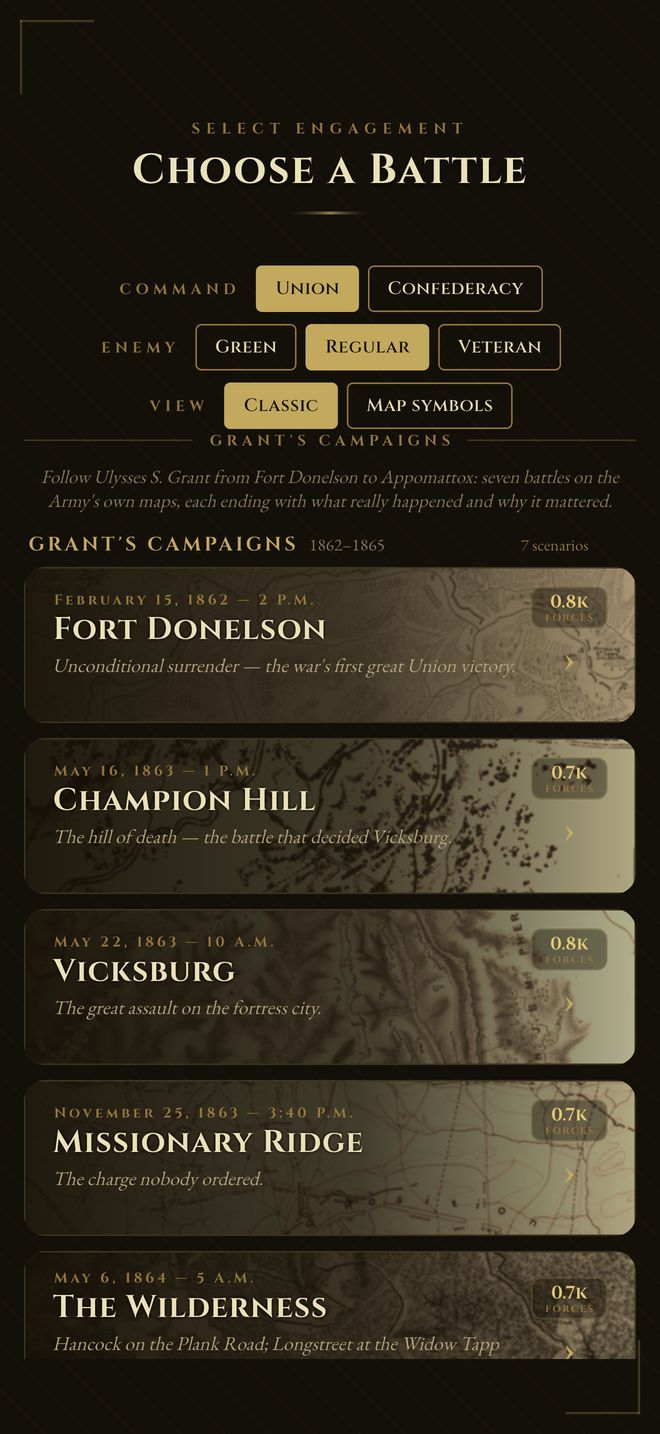
Grant's Campaigns in the battle list on iPhone
41battles
18free to play
200+named commands
5minutes a battle
New: the Drill Field

Learn to command in five minutes.

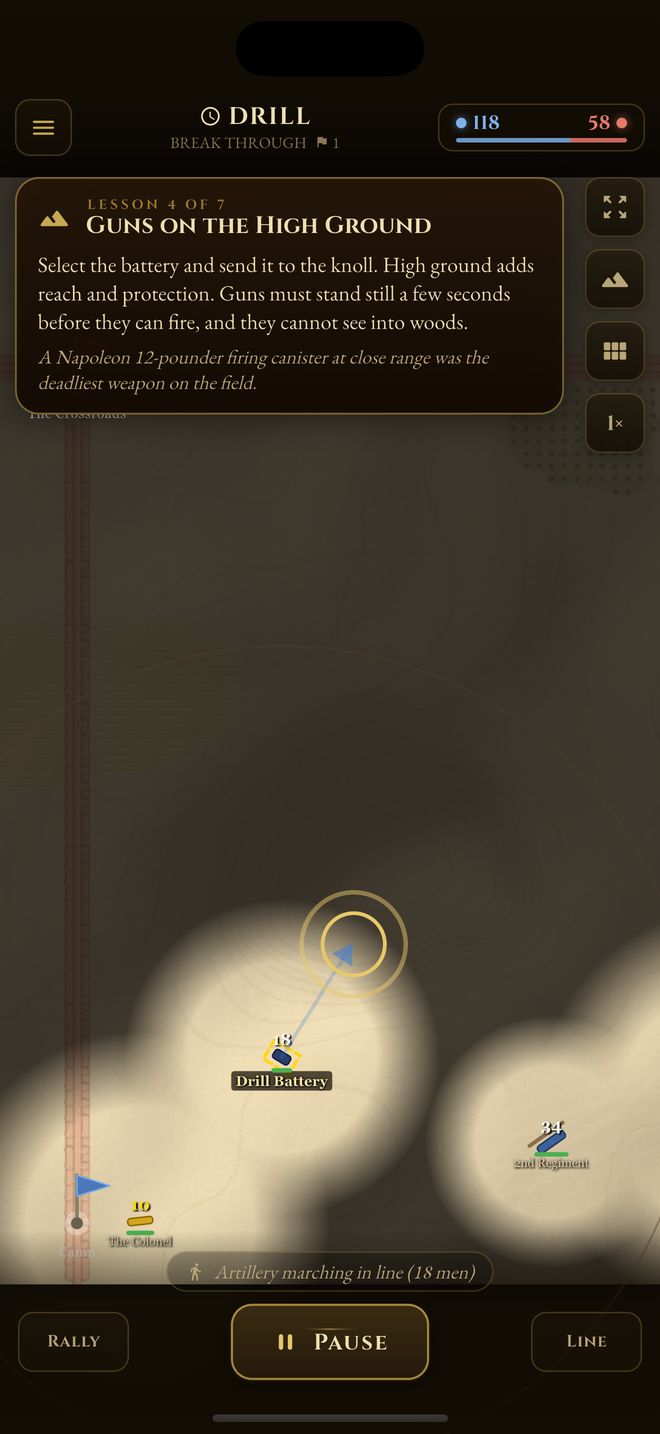
Never played a wargame? Start on the Drill Field. Seven guided lessons take you from your first order to taking an enemy flag, and each one waits until you have actually done it.

  1. Select a regiment. The ring around it is how far its rifles reach.
  2. March into the woods. Men in cover take less than half the losses.
  3. Choose a formation. Line, column or skirmish order.
  4. Guns on the high ground. Reach, protection, canister.
  5. Hold the line. Let them cross the open ground.
  6. Turn their flank. The strongest move in the game.
  7. Take the crossroads. Flags win battles.

Then keep the Field Manual open beside you: ten short chapters on how the game works and how the war was fought, from Hardee's drill to Little Round Top.

A Drill Field lesson: guns on the high ground
Take the field

Eighteen battles free. Six campaigns to follow.

Every battle is short: five minutes to break the line or hold it. Play either side, at three levels of difficulty.

Free

  • Antietam, Gettysburg, Chancellorsville and Shiloh
  • The opening battle of each campaign: Gettysburg's first day, the Cornfield at Antietam, the Hornet's Nest at Shiloh, Fort Donelson, Perryville, Ball's Bluff, Pea Ridge and First Bull Run
  • Forgotten Fields: Roanoke Island, New Bern, Secessionville, Cedar Mountain, Irish Bend and Fort Wagner, lesser-known battles fought in part by Connecticut regiments

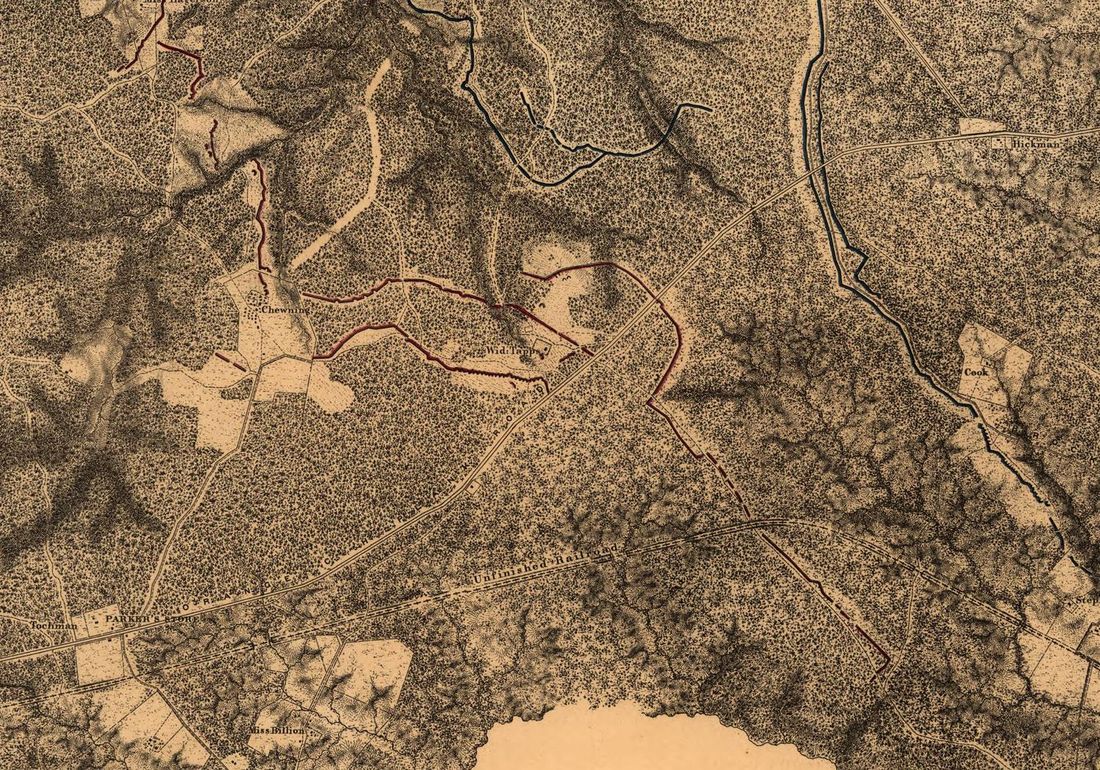
Historical Campaigns

Gettysburg day by day, Antietam hour by hour from the Cornfield to Burnside's Bridge, and both days at Shiloh. Eight scenarios on the period surveys, with more than two hundred named commands placed where the surveys put them.

Grant's Campaigns

Follow Ulysses S. Grant from Fort Donelson to Appomattox: Champion Hill, the assault on Vicksburg, Missionary Ridge, the Wilderness, the Bloody Angle at Spotsylvania, and the last attack of Lee's army.

The Western Campaigns

The war beyond Virginia: Bragg and Buell at Perryville, Longstreet's breakthrough and Thomas's stand at Chickamauga, Sherman's assault on Kennesaw Mountain, Hood's attack and the death of McPherson at Atlanta, and Olustee, the largest battle fought in Florida. Perryville is free to play.

River Crossings

Five battles fought at the water, asked for by our players: Ball's Bluff on the Potomac, Dam No. 1 on the Warwick, Fredericksburg on the Rappahannock, the North Anna, and Natural Bridge in Florida, where reserves, militia and cadets saved Tallahassee. Florida regiments are there wherever they fought. Ball's Bluff is free to play.

High Ground

Hood's last campaign and four more fights for the hills: Pea Ridge in Arkansas, New Hope Church in Georgia, Fisher's Hill in the Shenandoah, and Franklin and Nashville in Tennessee, where the United States Colored Troops charged Peach Orchard Hill and the Confederate line broke at Shy's Hill. Pea Ridge is free to play.

New in version 1.9

Early Battles

The first year of the war, when both armies were green: First Bull Run and Jackson's stand on Henry House Hill, Lyon's fight for Bloody Hill at Wilson's Creek, Thomas in the rain at Mill Springs, Hooker against Fort Magruder at Williamsburg, D. H. Hill at Seven Pines, and Hood's Texans breaking Porter's line at Gaines' Mill. First Bull Run is free to play.

Each campaign is a one-time purchase, and the first two come as a bundle for less. Purchases restore on all your devices.

The battles

Every battle in the game, in the order it was fought: what you command, what really happened, and whether it is free.

Colton's 1862 map of the seat of war, with every battle marked

A campaign map of the whole war

Every battle sits where it was fought on Colton's 1862 map. March a campaign in order and the army you finish one battle with is the army you start the next.

Real tactics

Fight it the way they had to.

Nothing here is decoration. These are the rules the battles run on.

Flanks and rear

A line fights to its front. Fire into a flank does half again as much harm; into the rear, two and a half times. Pin them from the front, then go around.

Halt to fire

Troops on the move manage scattered shots at a third of their strength. A halted line delivers full volleys.

Cover and ground

Woods, stone walls, sunken roads and earthworks double a unit's protection or more. High ground adds reach. Men who hold still dig in.

Artillery

Guns unlimber before they fire, double their bite with canister at close range, and cannot see into woods. Infantry that reach a battery overrun it.

Line, column, skirmish

Column marches 40% faster but bleeds under fire. Skirmish order halves both losses and firepower. Line fights hardest.

Nerve and cartridges

Units break when morale goes, and rally near flags, generals and friends. About three and a half minutes of steady fire empties a cartridge box.

The ground

The real maps, or a plain one.

Play on the surveys the armies and historians drew, from Bachelder's Gettysburg to Michler's survey of the Wilderness, or switch to a quiet documentary-style map drawn from the same ground.

The Wilderness on Michler's period survey
Period survey
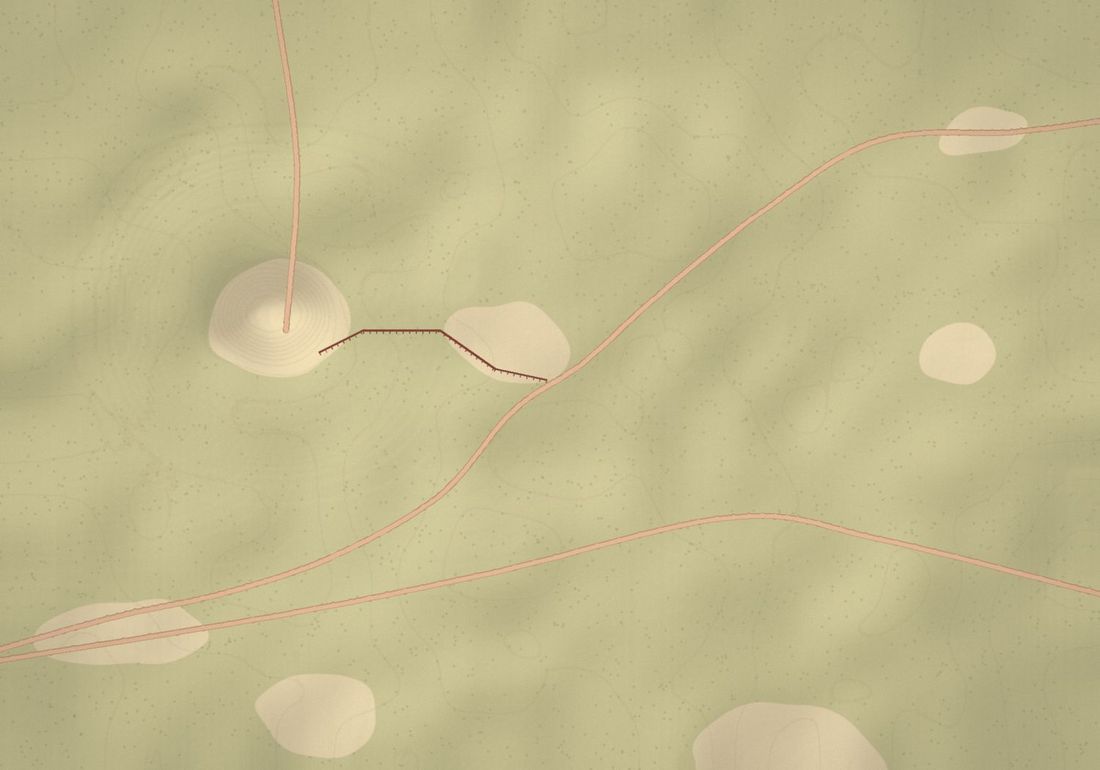
The Wilderness on the documentary-style map
Documentary map
What really happened at Appomattox The after-action report
Learn as you play

Then find out what really happened.

Every campaign battle ends with the history: what happened, why it mattered, and the words of the people who were there.

The after-action report counts your losses in men, scaled to the armies that really fought, and sets them beside the real casualty figures. Win the day, or change history.

Made for history readers, students and teachers as much as for wargamers.

Now on the Mac

Made for mouse and keyboard.

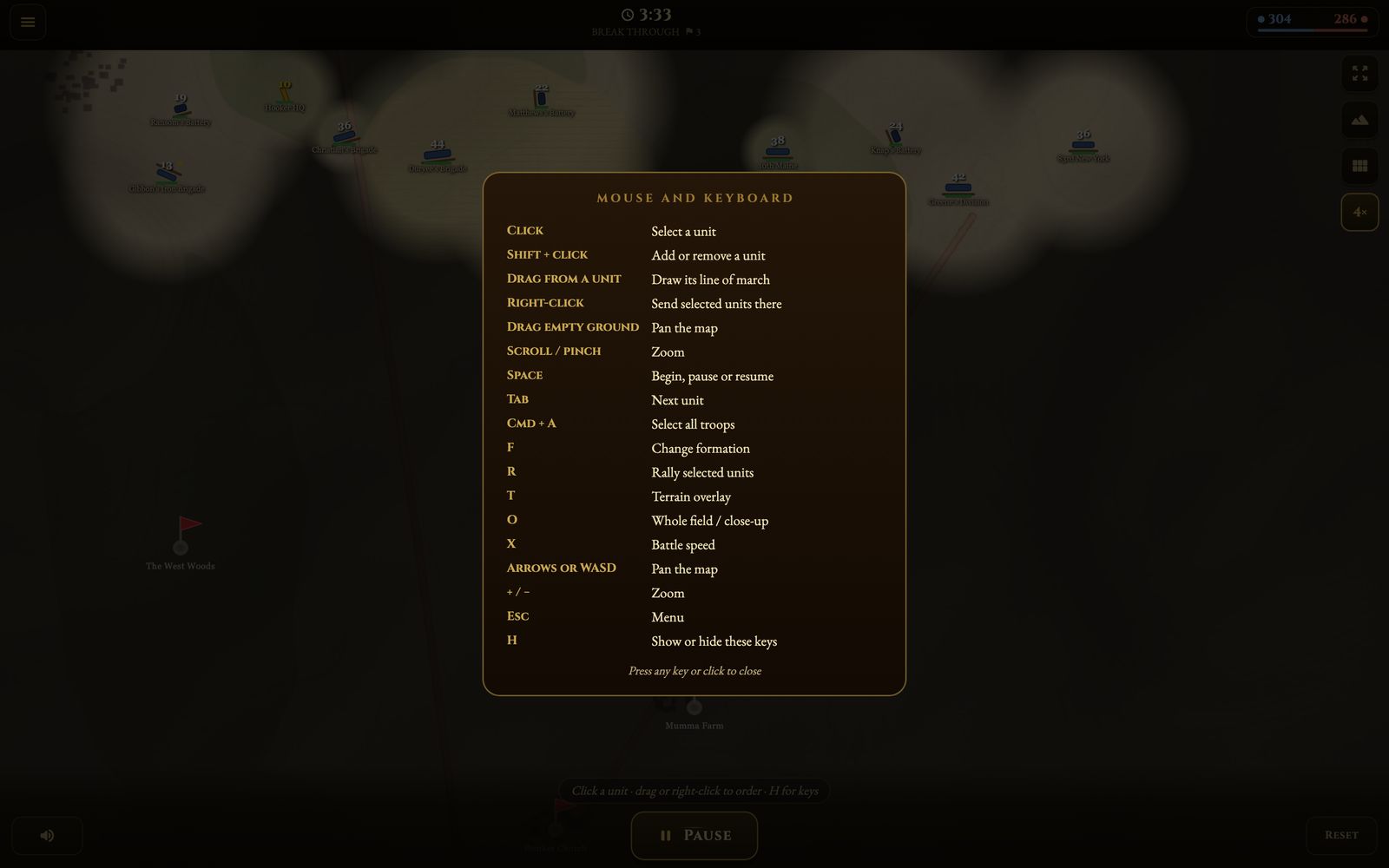
The Mac version is a full desktop game, not a phone app in a window. Click to select, drag or right-click to order, scroll to zoom, shift-click to build a brigade, and a key for every command. One purchase covers iPhone, iPad and Mac.

The Mac version's keyboard reference over a battle

Questions

Is it really free?

Yes. Eighteen battles, the Drill Field and the Field Manual are free, with no time limits or energy meters. The Historical Campaigns, Grant's Campaigns, The Western Campaigns, River Crossings, High Ground and Early Battles are optional one-time purchases.

How long is a battle?

Five minutes on the clock. The attacker has to break the line before nightfall; the defender has to hold at least one flag with a quarter of the army left.

Can I play the Confederacy?

Yes. Every battle can be fought from either side, against a Green, Regular or Veteran enemy.

Will my purchases carry over to a new device?

Yes. Purchases are tied to your Apple ID and restore on every iPhone, iPad and Mac you sign in to.

Does the game collect my data?

No. There are no accounts and no analytics in the app. See the privacy policy.

Is it historically accurate?

The maps, the commands and their positions come from the period surveys and official records. Strengths are the game's own counters, scaled back to real numbers in the after-action report.

Does it use Game Center?

Yes. Sign in to Game Center to earn twenty-one achievements and post your victories to the Victories leaderboard. From version 1.9.1 every win also earns a battle score: 100 for the win, up to 60 more for losing fewer men than history did, 40 more for changing the result, and half again on Veteran. Your best score on each field adds up to your General's Score, on its own leaderboard. Without Game Center, nothing changes.

Take the field.

Download on the App Store

Free on iPhone, iPad and Mac.